


🎉📖Discover Troy Anderson’s Inspiring Book Collection🎉📖
Battle Ready News is a reader-supported publication. If you enjoy our articles and videos, please consider becoming a paid subscriber. You will receive access to read in-depth articles, watch exclusive interviews, and partner in our mission to spread the Good News of Jesus Christ and prepare the world for His return.
Operation Epic Fury, the Collapse of Tehran’s War Machine, and What Comes Next for the Middle East
Operation Epic Fury and the Rapid Collapse of Tehran’s War Machine
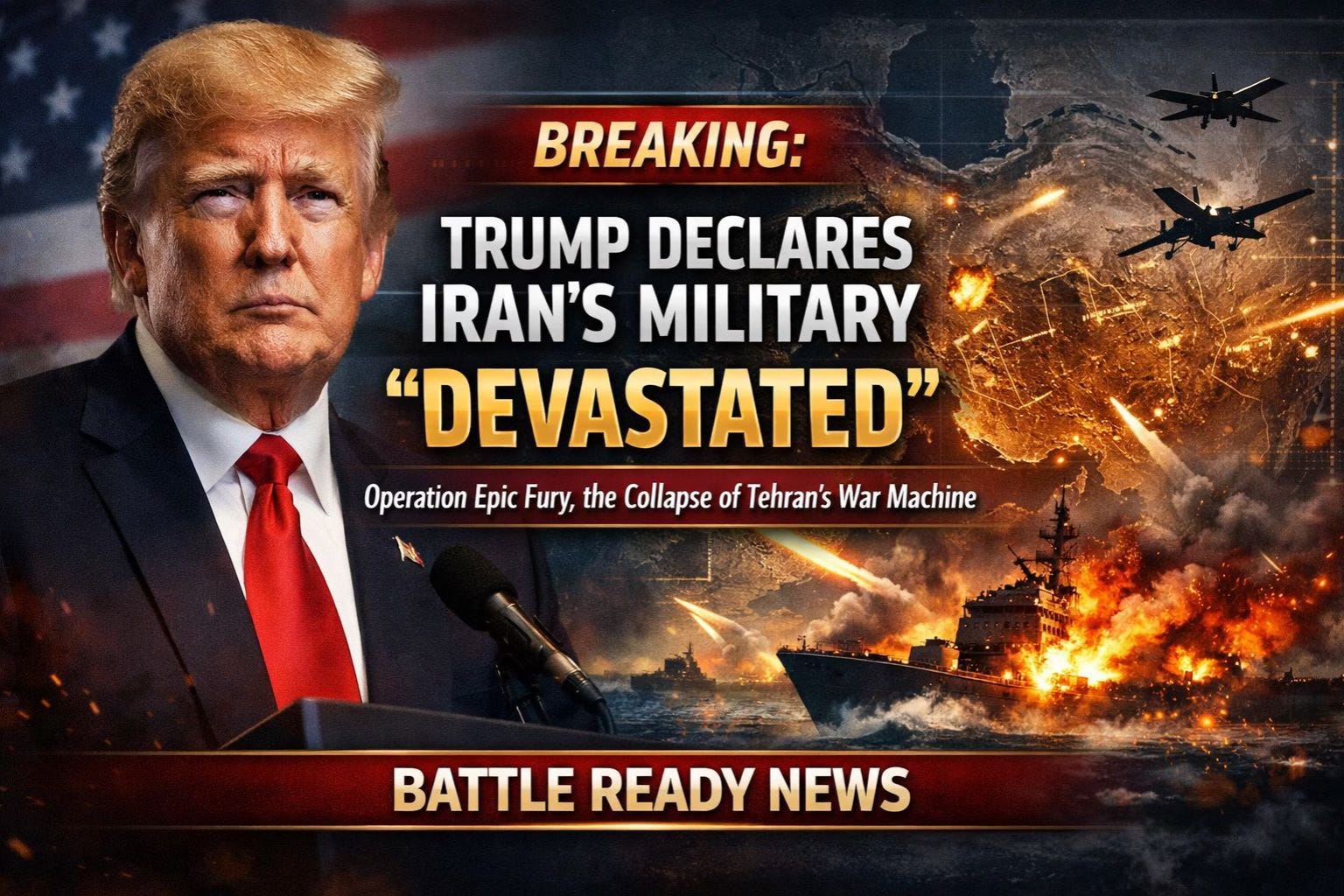
In a dramatic emergency news conference that sent shockwaves across global political and financial circles, President Donald Trump announced that U.S. forces have dealt a crushing blow to Iran’s military infrastructure, declaring that the regime’s naval power, missile systems, and drone capabilities have been severely crippled.
Speaking before reporters during a live broadcast that reverberated across international media and financial markets, Trump described the campaign—dubbed Operation Epic Fury—as one of the most decisive military operations in recent history.
“We’ve wiped every single force in Iran out very completely,” Trump said. “Most of Iran’s naval power has been sunk.”
According to the president, dozens of Iranian warships—roughly fifty or more—have been destroyed and now lie at the bottom of the sea, effectively neutralizing much of the country’s maritime military presence.
The announcement signals a dramatic escalation in the confrontation between Washington and Tehran and may mark a turning point in the long-running conflict between Iran and Western allies in the Middle East.
Meanwhile, Iran named Mojtaba Khamenei, the son of the recently killed supreme leader Ayatollah Ali Khamenei, as his father’s successor, signaling the continuity of hard-line theocratic rule.
A Rapid Military Campaign
Trump revealed that U.S. forces have already struck more than 5,000 targets across Iran, targeting a wide range of strategic assets including missile launch sites, drone production facilities, underground weapons depots, and command centers linked to the Iranian military leadership.
The campaign, according to the president, has unfolded with remarkable speed.
Within days of the first strikes, Trump claimed Iranian missile launch capability had fallen by nearly 90 percent, while the regime’s drone launch capacity had dropped more than 80 percent.
American stealth bombers—including B-2 aircraft capable of delivering deep-penetrating bunker-buster bombs—have reportedly struck multiple underground facilities believed to house missile launchers and weapons manufacturing operations.
“The soil was no match,” Trump said while describing the deep underground targets hit by American bombers.
He emphasized that U.S. intelligence had mapped Iran’s weapons manufacturing infrastructure in detail and that strikes were continuing against drone and missile factories across the country.
“The shaking removes what can be shaken, so that what cannot be shaken may remain.” — Hebrews 12:27
Designated Disrupter: Trump and Other Unlikely Agents of Revival
(Charisma House/FrontLine, January 6, 2026) | From Pulitzer Prize–nominated journalist and six-time #1 bestselling author Troy Anderson, Designated Disrupter, the #2 “Hot New Release in “Church & State Religious Studies” on Amazon, reveals how God is using “designated disrupters” to confront evil, disrupt corruption, and awaken a generation now breaking out in revival. Discover your role in the unfolding global awakening. Order now.
The Nuclear Threat That Triggered the Conflict
Central to the administration’s justification for the operation is the claim that Iran was rapidly moving toward acquiring nuclear weapons.
Trump asserted that American intelligence had concluded the Iranian regime was rebuilding its nuclear weapons program after previous facilities were destroyed and had rejected diplomatic proposals designed to limit uranium enrichment.
The president claimed Iran had even refused offers for unlimited civilian nuclear fuel, insisting instead on maintaining enrichment capabilities that Western officials feared could quickly produce weapons-grade material.
“If we didn’t knock out their nuclear potential,” Trump said, “they would have had a nuclear weapon.”
He warned that such a weapon could have been deployed against Israel or used to threaten American military bases in the region.
In Trump’s telling, the operation was therefore not simply a retaliatory strike but a preemptive effort to prevent a nuclear-armed Iran.
The Strategic Battle for the Strait of Hormuz
Beyond the immediate military confrontation, Trump’s remarks also underscored the enormous geopolitical stakes surrounding the Strait of Hormuz, one of the most important energy corridors in the world.
Nearly twenty percent of global oil supplies pass through the narrow waterway connecting the Persian Gulf to international shipping lanes.
Trump vowed that the United States would not allow Iran to disrupt that flow.
“We will not allow a terrorist regime to hold the world hostage,” he said.
The administration is reportedly considering several measures to stabilize energy markets and protect global oil shipments, including providing political risk insurance for commercial tankers operating in the region and potentially escorting vessels with U.S. naval forces.
If Iran attempts to block the strait or target energy infrastructure, Trump warned, American forces would respond with overwhelming force.
We are in a spiritual war—and neutrality is not an option.
The Military Guide to Armageddon, a #1 bestseller by Col. David Giammona and Troy Anderson, equips believers with battle-tested spiritual warfare strategies drawn from Scripture and real-world military experience. Learn how to stand firm, sharpen discernment, and prepare your life and soul as prophecy and global events collide. Be disciplined. Be courageous. Be battle ready. Get your copy here on Amazon.
Regional Alliances Shift
One of the most striking revelations in Trump’s remarks was the claim that Iran’s own actions may have triggered a regional backlash against Tehran.
According to the president, Iranian missile attacks against neighboring states—including Gulf nations that had previously remained neutral—pushed several countries to align with the United States.
Saudi Arabia, the United Arab Emirates, and other regional partners have reportedly joined defensive efforts against Iranian missile and drone attacks.
Trump suggested that Tehran’s strategy backfired dramatically.
“They attacked their neighbors,” he said. “And the neighbors came onto our side.”
If accurate, this shift could significantly alter the strategic balance of power across the Middle East.
Leadership Crisis Inside Iran
Trump also indicated that the Iranian leadership structure has been severely disrupted by the military campaign.
According to the president, multiple layers of leadership within Iran’s military and political hierarchy have been eliminated during the operation.
“Two levels of leadership are gone,” he said.
The loss of senior commanders and strategic planners could leave the Iranian regime struggling to coordinate its remaining military forces.
Trump hinted that Iran may ultimately need to install new leadership capable of pursuing a more peaceful course.
“We think they should put somebody in charge who can do something peacefully for a change,” he said.

Time Travel. Prophecy. Power. The code behind America’s destiny revealed.
Unlock the mystery. Discover the code behind America’s destiny. In The Trump Code (Charisma House/FrontLine), Pulitzer Prize–nominated investigative journalist and six-time #1 bestselling author Troy Anderson takes readers on a gripping journey through history, prophecy, and current events—revealing astonishing connections between Ingersoll Lockwood’s The Baron Trump Collection, America’s destiny, and the Trump phenomenon. From time travel theories and Nikola Tesla to hidden lineages and prophetic turning points, this explosive bestseller challenges conventional narratives and calls readers to discern the times we are living in.
Global Diplomacy in Motion
The crisis is also reshaping diplomatic relationships among the world’s major powers.
During the press conference, Trump confirmed that he had held a phone call with Russian President Vladimir Putin earlier in the day.
The two leaders discussed both the Middle East crisis and the ongoing war in Ukraine.
Trump suggested that Putin expressed interest in helping stabilize the region, though the president added that ending the Russia-Ukraine war would be a more meaningful contribution to global peace.
The president also referenced America’s ongoing relationship with China, noting that Beijing depends heavily on energy shipments passing through the Strait of Hormuz.
“We’re protecting the world,” Trump said, suggesting that even geopolitical rivals benefit from maintaining open energy routes.
The Human Cost of War
Despite the confident tone of the announcement, Trump acknowledged that the conflict has already claimed American lives.
Reports indicate that U.S. service members have died in operations linked to the campaign.
The president described meeting the families of fallen soldiers at Dover Air Force Base and said they shared a common message.
“Finish the job,” Trump said the families told him.
The moment served as a stark reminder that even the most technologically advanced military operations carry a human cost.
A Doctrine of “Peace Through Strength”
Throughout the press conference, Trump returned repeatedly to the guiding principle that has defined his foreign policy approach: peace through strength.
In his view, decisive military action can prevent larger wars by eliminating threats before they fully materialize.
Trump argued that Iran had been preparing to dominate the Middle East through a combination of ballistic missiles, drone warfare, and nuclear ambitions.
“Iran was going to take over the Middle East,” he said.
The administration now believes the operation has stopped that plan—at least for the foreseeable future.
Trump vs. The Beast exposes the accelerating rise of the Antichrist system foretold in Scripture—revealing how global power, deception, and prophecy are converging in a battle that will decide the fate of nations and the Church. Pre-order Trump vs. The Beast (Humanix Books/Newsmax Media, May 5, 2026) by Pastor Paul Begley and Troy Anderson.
Battle Ready Perspective
The coming weeks may determine whether Operation Epic Fury becomes a short, decisive conflict—or the opening chapter of a broader regional confrontation.
What is already clear, however, is that the Middle East has entered a new and unpredictable phase.
Iran’s military capabilities appear severely degraded, but history has shown that conflicts in the region rarely end as quickly as they begin.
The world now waits to see whether Tehran escalates, retreats, or attempts to rebuild its shattered military apparatus.
For now, the message from Washington is unmistakable:
The United States believes it has struck a decisive blow—and it is prepared to strike again if necessary.
Prophetic Watch: Could This Align With Biblical End-Times Warnings?
For many readers of Battle Ready News, events unfolding in the Middle East are not viewed solely through a geopolitical lens but also through the framework of biblical prophecy.
The Bible repeatedly identifies the Middle East—and particularly the region surrounding Israel—as a focal point of end-times conflict. Several prophetic passages describe alliances and confrontations involving nations that correspond geographically with modern powers in the region.
One of the most widely discussed passages is Ezekiel 38–39, which describes a coalition of nations assembling against Israel in what many scholars call the Gog-Magog conflict. The prophecy references territories historically associated with regions north of Israel and parts of modern Iran and Turkey.
While scholars debate the exact timing and interpretation of these prophecies, many observers note that Iran—historically known as Persia—is specifically mentioned in the Ezekiel account.
In recent years, Iran has emerged as one of Israel’s most aggressive adversaries, supporting proxy forces across the region and repeatedly declaring its intention to eliminate the Jewish state.
Trump’s announcement that Iran’s military capabilities have been severely weakened may therefore have implications beyond immediate military strategy.
If Iran’s regional influence is reduced or destabilized, the broader alignment of Middle Eastern powers could shift dramatically.
Some analysts suggest that weakening Tehran’s military infrastructure could temporarily delay regional conflict. Others warn that instability inside Iran could eventually produce even more unpredictable alliances.
For Christians who closely follow biblical prophecy, the current crisis serves as a reminder that geopolitical events in the Middle East often unfold with astonishing speed—and can reshape the global landscape almost overnight.
Whether the current conflict represents a step toward the fulfillment of biblical prophecy remains a matter of debate. But few would deny that the region is once again at the center of history.
Five Strategic Consequences of Operation Epic Fury
Even if the conflict de-escalates in the coming weeks, Operation Epic Fury could produce lasting strategic consequences for the Middle East and the broader world.

Discover the wonder of Heaven. I’ve Been to Heaven, the #1 “Hot New Release” in “Near-Death Experiences” on Amazon and an Evangelical Christian Publishers Association (ECPA) Bestseller by Steve and Kathy Boyls, M.D., and Troy Anderson, offers a powerful, firsthand glimpse of eternity—reminding readers that hope is real, love is everlasting, and God’s promises are true.
1. Iran’s Military Deterrence May Be Severely Damaged
If Trump’s claims about the destruction of Iran’s naval forces and missile systems prove accurate, Tehran’s ability to project military power across the Persian Gulf could be dramatically reduced.
This would weaken Iran’s leverage over neighboring states and diminish its ability to threaten maritime traffic through the Strait of Hormuz.
2. Israel’s Strategic Position Could Be Strengthened
Israel has long viewed Iran’s nuclear program as its most significant existential threat.
If Iranian nuclear infrastructure has indeed been destroyed or severely damaged, Israel’s strategic position in the region could improve significantly—at least in the short term.
3. Gulf Nations May Move Closer to Washington
Countries such as Saudi Arabia, the United Arab Emirates, and Qatar have historically balanced their relationships between Washington and regional powers.
Iranian missile attacks against Gulf states may push these nations to deepen security cooperation with the United States and Israel.
Such a shift could accelerate the formation of new regional defense alliances.
4. Global Energy Markets Could Be Reshaped
The Strait of Hormuz remains one of the most important oil transportation routes in the world.
Any prolonged conflict in the region has the potential to disrupt global energy supplies, driving volatility in oil prices and impacting economies worldwide.
Trump’s pledge to protect shipping routes signals that Washington recognizes the enormous economic stakes.
5. The Risk of Escalation Remains
Despite claims of military success, conflicts involving Iran have historically been complex and unpredictable.
Tehran has developed a vast network of proxy forces throughout the Middle East, including militias and paramilitary groups capable of launching attacks beyond Iran’s borders.
Even if the Iranian military itself has been weakened, these networks could continue to influence regional stability.
Revelation 911 reveals the prophetic signs converging before our eyes—are you ready? The #1 bestseller Revelation 911 (Salem Books/Regnery Publishing) by Pastor Paul Begley and bestselling journalist Troy Anderson connects end-times prophecy with breaking global events. This urgent book calls believers to discern the times, anchor their hope in Christ, and be ready for His soon return
Battle Ready Watch
For now, the world is watching closely to see how Tehran responds.
Will the Iranian leadership seek negotiations, attempt retaliation through proxy forces, or move to rebuild its military capabilities?
Trump believes the campaign has fundamentally changed the balance of power.
But history reminds us that the Middle East rarely moves in straight lines.
The coming weeks may reveal whether Operation Epic Fury marks the end of a conflict—or the beginning of a new chapter in one of the world’s most volatile regions.
Trump’s War Doctrine: Why He Says Iran Had to Be Stopped Now
Throughout the emergency press conference, President Trump repeatedly returned to a central theme that has defined his foreign policy worldview for years: peace through strength.
In Trump’s view, the greatest danger facing the United States and its allies is not confrontation itself, but hesitation in the face of emerging threats.
According to the president, intelligence reports suggested Iran was rapidly rebuilding the infrastructure needed to produce nuclear weapons while simultaneously expanding its arsenal of ballistic missiles and drone systems.
Trump described a scenario in which Tehran could soon have possessed both nuclear warheads and the missile delivery systems capable of striking not only Israel but also American military bases throughout the Middle East.
The administration concluded that waiting longer would only allow Iran to strengthen its position.
“The situation was approaching the point of no return,” Trump said.
From this perspective, Operation Epic Fury was not merely a military campaign—it was a strategic intervention intended to prevent a much larger war in the future.
Trump argued that allowing Iran to acquire nuclear weapons would have fundamentally altered the balance of power in the Middle East, potentially triggering a nuclear arms race across the region.
Saudi Arabia, Turkey, and other powers might have pursued their own nuclear capabilities in response, dramatically increasing the risk of catastrophic conflict.
Instead, the administration believes the strikes have reset the strategic landscape.
Trump claimed Iran’s navy has been largely destroyed, its missile launchers dramatically reduced, and its nuclear infrastructure severely damaged.
If those assessments prove accurate, Iran could require years—perhaps even a decade—to rebuild its military capabilities.
Supporters of the operation say the campaign demonstrates that decisive action can reshape geopolitical realities.
Critics warn that military victories do not always produce long-term stability.
History offers examples of both outcomes.
Yet Trump insists that the alternative—allowing Iran to continue advancing toward nuclear weapons—would have been far more dangerous.
“I said in 2015 I would stop Iran from getting nuclear weapons,” Trump told reporters. “All I’m doing now is keeping my promise.”
For supporters of the president’s strategy, Operation Epic Fury represents the clearest expression yet of the doctrine that has guided Trump’s approach to global security.
A doctrine built on the belief that deterrence is strongest when backed by overwhelming force.

.You are not a bystander—you are called. Your Mission in God’s Army equips you to discover your faith-filled assignment and walk boldly in these end times. Audiobook available now. Buy here: https://amzn.to/49CDrvf
What Happens Next: Three Possible Paths for the Middle East
Even as President Trump declared the military campaign against Iran a decisive success, the question now facing the world is simple but profound:
What happens next?
History shows that conflicts in the Middle East rarely follow predictable paths. While the destruction of major military assets can change the balance of power overnight, the political and strategic consequences often unfold more slowly—and sometimes in unexpected ways.
At this stage, analysts see three possible scenarios emerging from the current crisis.
Scenario One: Rapid De-Escalation
The first possibility is that Iran’s leadership, recognizing the severe damage inflicted on its military infrastructure, may choose to step back from further escalation.
If Iran’s naval fleet, missile systems, and drone capabilities have indeed been reduced as dramatically as the administration claims, Tehran may calculate that direct confrontation with the United States would be too costly.
In that case, the Iranian government could seek diplomatic channels to stabilize the situation while quietly rebuilding its military over time.
Under this scenario, the conflict could cool quickly, allowing regional powers to shift back toward negotiations and economic recovery.
This is the outcome Trump appears to believe is most likely.
Scenario Two: Proxy Escalation
A second possibility involves a more indirect response.
For decades, Iran has built an extensive network of regional allies and proxy groups across the Middle East. These organizations—including militias and armed factions in multiple countries—have often served as Tehran’s extended reach beyond its own borders.
If Iran chooses not to confront the United States directly, it could instead activate these networks.
Such a strategy could produce smaller but persistent conflicts across several regions simultaneously—targeting military bases, shipping lanes, or allied governments.
This type of asymmetric warfare has long been a cornerstone of Iranian military doctrine.
Even if Iran’s conventional military power has been weakened, these networks could still influence regional stability for years.
Scenario Three: Regional Confrontation
The third and most dangerous scenario would involve a broader regional war.
If Iran attempts to retaliate directly—perhaps through large-scale missile strikes or attacks on energy infrastructure—other nations could be drawn into the conflict.
Countries such as Saudi Arabia, Israel, and Gulf allies could respond with additional military operations, expanding the scope of the war.
Because the Middle East is one of the world’s most strategically important energy regions, such escalation could also trigger global economic shockwaves, affecting oil markets, trade routes, and financial systems.
While leaders on all sides say they want to avoid such an outcome, history has shown that regional conflicts can sometimes spiral beyond the intentions of the actors involved.
A World Watching Closely
For now, the world waits.
President Trump believes Operation Epic Fury has fundamentally changed the strategic balance in the Middle East, halting Iran’s ambitions before they could fully mature.
Whether that assessment proves correct will likely depend on how Tehran responds in the days and weeks ahead.
What is certain, however, is that the events unfolding now represent one of the most significant military confrontations between the United States and Iran in modern history.
The world is entering a new and uncertain chapter—and what happens next in Iran could reshape the Middle East, global energy markets, and international security for years to come.
Editor’s Note:
This report summarizes President Trump’s emergency press conference regarding the military campaign against Iran known as Operation Epic Fury. The situation is rapidly evolving, and developments may change in the hours and days ahead.
A Prayer for Peace, Wisdom, and Protection
Heavenly Father,
We come before You today recognizing that You are the sovereign Lord over every nation, every leader, and every moment in history. Your Word reminds us that the kingdoms of this world ultimately belong to You, and that nothing unfolds outside of Your knowledge or Your purposes.
Lord, as tensions rise in the Middle East and the world watches events unfold with uncertainty and concern, we ask for Your mercy, Your wisdom, and Your divine intervention.
We pray for the leaders of nations—President Trump and those advising him, leaders throughout the Middle East, and leaders across the world. Grant them wisdom beyond human understanding. Guide their decisions so that they pursue justice, peace, and the protection of innocent lives.
Father, we pray for the brave men and women serving in the armed forces. Place Your hand of protection upon them. Surround them with Your angels. Give them courage, clarity, and safety in every mission they undertake.
We also pray for the people living in the regions affected by conflict. Comfort families who are afraid, heal those who are suffering, and protect the innocent from violence and destruction.
Lord, we ask that You restrain the forces of evil, violence, and chaos. Bring an end to terror, hatred, and war. Let peace prevail where conflict now threatens to spread.
And in the midst of uncertainty, help us remember that You are our refuge and strength, a very present help in times of trouble. May Your will be done on earth as it is in heaven.
We place our trust in You.
In the name of Jesus Christ we pray,
Amen.
A Prayer of Salvation
If you are reading this and have never invited Jesus Christ into your life, you can begin that journey right now. The Bible tells us that God loves you and that salvation is a gift available to everyone who calls on His name.
If you would like to receive that gift, pray this prayer sincerely from your heart:
Lord Jesus,
I come to You today recognizing that I need Your grace. I acknowledge that I have sinned and fallen short, and I ask for Your forgiveness.
I believe that You are the Son of God. I believe that You died on the cross for my sins and rose again so that I could have eternal life.
Today I turn away from my sins and I invite You into my life. Be my Lord and my Savior. Fill me with Your Holy Spirit and guide me in the path of truth.
Help me to follow You, to grow in faith, and to live according to Your will.
Thank You for loving me, forgiving me, and giving me a new beginning.
In Jesus’ name I pray,
Amen.
A Final Word to Our Readers
Dear friends,
We are living in extraordinary times.
Events that once seemed distant headlines are now unfolding rapidly before our eyes—wars, global tensions, shifting alliances, and historic decisions that may reshape the future of nations.
Moments like these can easily stir fear, uncertainty, or confusion. But as believers, we are reminded that our hope does not rest in governments, military strength, or political power. Our hope rests in the unchanging promises of God.
The Bible tells us that God is not surprised by the events of our world. He is the Alpha and the Omega—the beginning and the end. Even in times of global turmoil, He remains sovereign over history.
This is why moments like these are also opportunities.
Opportunities for believers to pray more fervently, to seek God more deeply, and to shine the light of Christ in a world searching for truth and hope.
We encourage you to continue praying for peace, for wisdom among world leaders, and for the protection of innocent lives. Pray for revival in our nations and for hearts to turn back to God.
And if this message has encouraged or informed you, please consider sharing it with friends and family. In times of uncertainty, truth, faith, and hope are more important than ever.
May the Lord bless you, guide you, and strengthen your faith in the days ahead.
Stay watchful. Stay faithful. Stay battle ready.
—
Troy Anderson and The Battle Ready News Team
Watch the Full Emergency Address
Watch the full emergency press conference streamed by commentator Benny Johnson here: Trump Speaking LIVE Right Now At Emergency News Conference | Major Iran Announcement
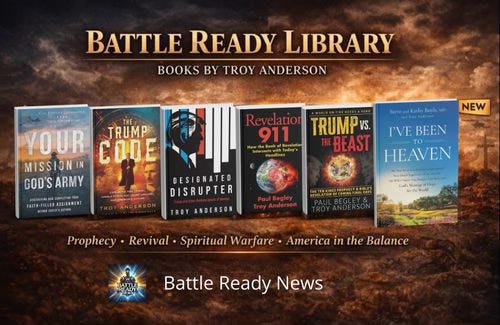
📚 Dive into Troy Anderson’s Prophetic Books:
📖 Trump vs. The Beast
📖 Designated Disrupter
📖 I’ve Been to Heaven
📖 The Trump Code
📖 Revelation 911
📖Your Mission in God’s Army
📖The Military Guide to Disarming Deception
📖The Military Guide to Armageddon
📖Trumpocalypse
📖The Babylon Code
Each of these books is more than a story—they are a call to courage, revival, and prophetic insight for such a time as this.

Your Book. Your Vision. Your Legacy! We believe your story matters. Whether you’re writing to impact hearts, spark revival, or leave a legacy for generations,
our team of bestselling ghostwriters, editors, and publishing experts will help bring your vision to life—from the first word to final release of your book. Let’s write a story that echoes into eternity. Visit www.inspireliterary.com to start your journey today. Contact six-time #1 bestselling author and Inspire Literary Group Founder Troy Anderson at troyanderson@inspireliterary.com or 949-887-1511 for a free consultation on your book/film/TV series idea.