


Thousands of Flights Disrupted as Communications Failures Trigger a Nationwide Aviation Shutdown—Trump Administration Calls for $50 Billion Overhaul Amid Growing National Security Concerns

📚 DISCOVER TROY ANDERSON’S BESTSELLING BOOK COLLECTION
Explore Troy Anderson’s bestselling books on biblical prophecy, national security, spiritual warfare, and faith—including The Trump Code, The Military Guide to Armageddon, I’ve Been to Heaven, Revelation 911, and his latest release, Trump vs. the Beast, coauthored with Pastor Paul Begley. Discover compelling insights and extraordinary stories to strengthen your faith, understand the times, and stand ready for the challenges ahead.
FAA Orders Nationwide Ground Stop
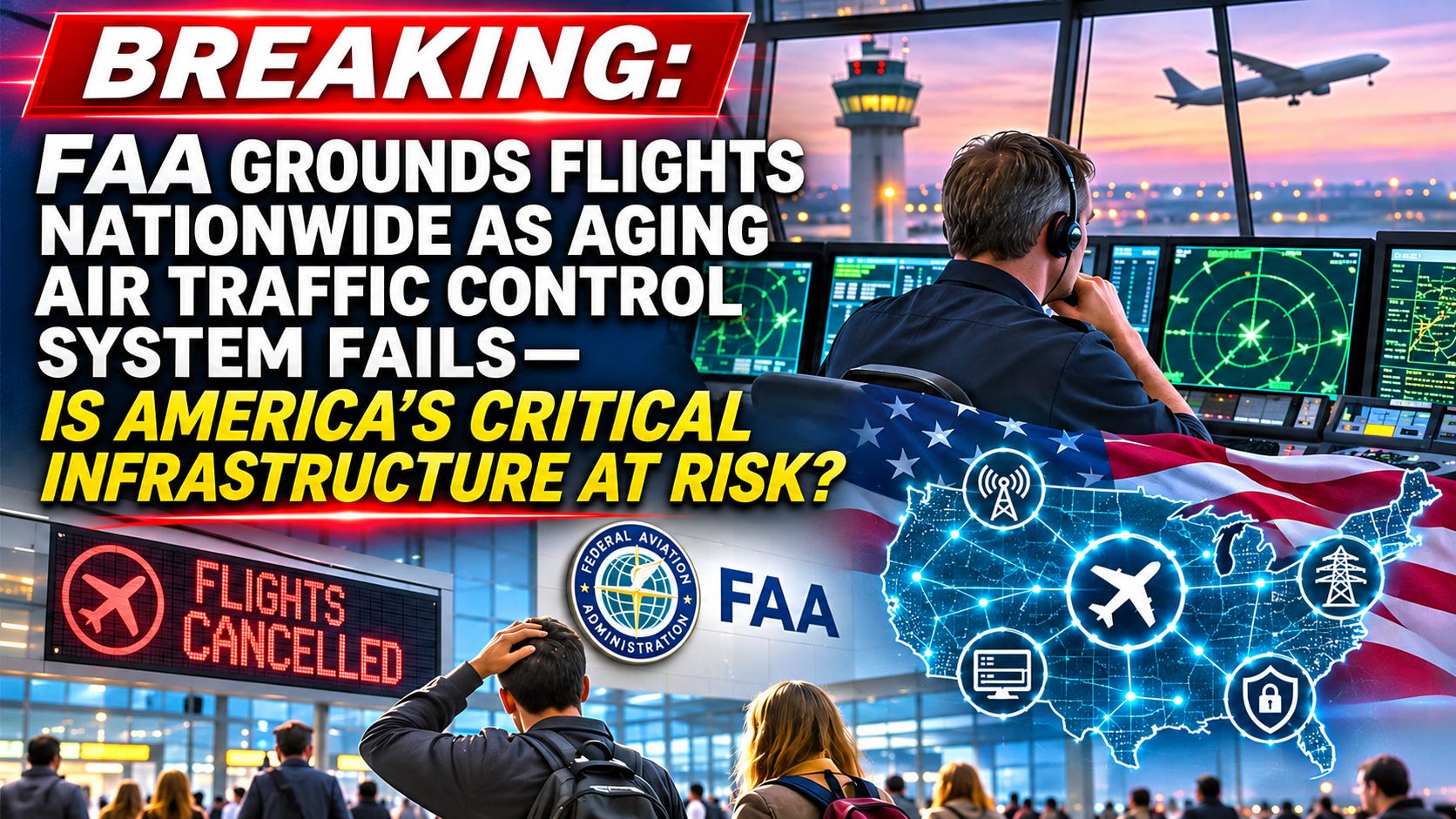
In an extraordinary aviation emergency that exposed troubling vulnerabilities in America’s critical infrastructure, the Federal Aviation Administration (FAA) ordered a nationwide ground stop on Friday, November 13, temporarily halting departures across the United States after failures involving aging telecommunications equipment disrupted radar information and communications used by air traffic controllers. The sweeping shutdown stranded passengers, disrupted thousands of flights, and raised urgent questions about the reliability of the technological systems responsible for keeping America’s skies safe.
Transportation Secretary Sean Duffy announced that the nationwide restriction was lifted at 8:15 p.m. Eastern Time after technicians stabilized the affected network, although the disruption continued to ripple through airline schedules as carriers struggled to reposition aircraft, restore flight crews, and accommodate stranded travelers. The emergency drew comparisons to the unprecedented aviation shutdown following the September 11, 2001, terrorist attacks and the nationwide ground stop caused by a federal aviation computer-system outage in January 2023.
Federal officials identified overloaded equipment within the FAA’s aging communications infrastructure as the apparent cause, while investigators continued examining the circumstances surrounding the failure. Although authorities reported no evidence establishing that the incident resulted from a cyberattack, the emergency raised a broader national-security question: How vulnerable are America’s transportation, energy, communications, and financial systems to cascading technological failures capable of disrupting essential services nationwide?
Support Our Mission—Become a Paid Subscriber Today. Your support helps sustain the investigative reporting, research, writing, and production behind Battle Ready News, empowering us to equip believers with biblical truth, spiritual discernment, courage, and hope while sharing the Good News of Jesus Christ with the world.
A Nationwide Aviation Emergency Unfolds
According to the timeline presented by federal transportation officials, the problems began at approximately 3:36 p.m. Eastern Time Friday, when air traffic control facilities experienced instability affecting radar data and communications. The disruptions reportedly involved regional Terminal Radar Approach Control facilities, known as TRACONs, and larger Air Route Traffic Control Centers responsible for managing aircraft traveling between airports. Together, these facilities form the backbone of America’s civilian aviation system, enabling controllers to monitor aircraft positions, maintain safe separation between flights, and coordinate communications across the national airspace.
As the problems emerged, the FAA issued a nationwide ground stop, preventing additional departures while controllers and pilots implemented established safety procedures for aircraft already airborne. Duffy said more than 3,500 aircraft were in flight when the emergency measures began, creating an enormous operational challenge for aviation personnel. Officials emphasized that the incident did not involve a complete nationwide loss of radar or radio communications; rather, inconsistent information and unstable telecommunications connections prompted the FAA to act out of an abundance of caution, while certain essential medical and emergency flights continued under special procedures.
The restriction lasted more than four hours, disrupting airline operations from coast to coast as thousands of travelers faced cancellations, delays, and missed connections. News reports described widespread flight disruptions, while airlines warned that restoring normal schedules could take additional time because aircraft and flight crews had been displaced from their planned locations. Although the immediate emergency ended when the FAA reopened the airspace, the consequences underscored how quickly a technological failure can affect transportation, commerce, medical logistics, and everyday life.

Discover Trump vs. the Beast
By Pastor Paul Begley and Troy Anderson | Forewords by Kevin Sorbo and Joseph Z
Could artificial intelligence, emerging global powers, and escalating geopolitical tensions be setting the stage for the rise of the Antichrist? Discover the compelling investigations, prophetic insights, and powerful message of faith and hope in Trump vs. the Beast: The Ten Kings Prophecy and the Bible’s Revelation of Coming Final Days (Humanix Books/Newsmax Media, October 6, 2026), the #1 “Best Seller” and #1 “Hot New Release” in “Prophecies” on Amazon.
What Really Failed? Aging Routers and Communications Equipment
During a White House briefing Friday evening, Duffy identified aging telecommunications equipment as the apparent source of the disruption, explaining that older switches and routers had become overloaded with data and begun producing inconsistent information across the air traffic control network. The affected equipment reportedly operated within a legacy telecommunications architecture using Time Division Multiplexing, or TDM, a technology developed decades ago to transmit multiple communications signals through shared channels. Although the technology remains useful in certain applications, aging hardware, outdated network architecture, and insufficient capacity can create operational vulnerabilities when critical systems must handle increasingly complex demands.
Duffy said newer internet-protocol-based equipment installed during ongoing modernization efforts did not experience the same problems, suggesting that updated infrastructure may offer greater reliability. Technicians reportedly reduced the overload and restored operations, but investigators must still determine precisely what triggered the malfunction and whether additional safeguards are necessary. The incident highlighted the challenge of maintaining a sophisticated national aviation system when portions of its underlying communications infrastructure rely on equipment designed during earlier generations of telecommunications engineering.
Concerns about aging FAA systems are not new. A 2024 Government Accountability Office assessment identified 51 of the agency’s 138 air traffic control systems as unsustainable and another 54 as potentially unsustainable, illustrating the scale of the modernization challenge.
Was America Under Cyberattack? Officials Examine Possible Threats
Almost immediately after the nationwide shutdown, speculation spread across social media about possible foreign interference, cyberattacks, and artificial intelligence failures. Some commentators questioned whether hostile governments or sophisticated hackers might have targeted America’s aviation infrastructure, while others suggested that newly introduced technological systems could have contributed to the disruption. Federal officials, however, said preliminary findings revealed no evidence establishing that the incident resulted from a cyberattack, although investigators continued reviewing the circumstances surrounding the emergency.
Questions also emerged about the FAA’s recently expanded SMART artificial intelligence aviation planning tool, but transportation officials said the system was not connected to the equipment that malfunctioned. No verified evidence has established that Iran, China, another foreign government, or an AI system caused Friday’s shutdown. Nevertheless, the incident demonstrates that critical infrastructure can face serious risks from equipment failures and inadequate redundancy even without deliberate sabotage, underscoring the need for reliable hardware, modern communications networks, effective cybersecurity defenses, and comprehensive emergency procedures.

Discover The Trump Code
By Troy Anderson | Seven-Time #1 Bestselling Author and Investigative Journalist
Could the 19th century Baron Trump novels by Ingersoll Lockwood, biblical prophecy, and extraordinary coincidences reveal a deeper story behind Donald Trump’s rise to power and America’s future? In The Trump Code, Troy Anderson explores remarkable historical parallels, prophetic mysteries, and the spiritual questions surrounding one of the most consequential political figures of our time. ORDER YOUR COPY TODAY
Trump Administration Calls for $50 Billion Aviation Overhaul
The aviation emergency renewed the Trump administration’s push for a sweeping modernization of America’s air traffic control infrastructure, with Duffy calling for approximately $50 billion to replace aging communications equipment, upgrade facilities, and strengthen the national airspace system. Administration officials have argued that decades of incremental repairs have left critical portions of the aviation network dependent on outdated infrastructure despite previous federal investments intended to improve reliability and performance. The administration has also highlighted $12.5 billion in previously secured funding as an initial investment toward a broader modernization program, while urging Congress to provide additional resources necessary to complete the overhaul.
The debate confronting lawmakers extends beyond funding alone because successful modernization will require effective engineering, cybersecurity protections, redundant communications networks, realistic project schedules, and careful oversight to ensure taxpayer investments deliver measurable improvements. Congress must also consider how quickly essential systems can be replaced without disrupting existing operations, particularly when aviation safety depends on continuous coordination among federal agencies, private contractors, pilots, and air traffic controllers. For millions of Americans who rely on commercial aviation, the reliability of the nation’s airspace infrastructure is a shared national priority transcending partisan politics.
A National Security Warning: How Vulnerable Is America’s Critical Infrastructure?
From a national-security perspective, Friday’s emergency highlights a challenge extending far beyond airports because America’s economy, military readiness, emergency services, financial networks, and daily life depend on interconnected technologies that must function reliably under extraordinary pressure. Electric utilities rely on communications networks, hospitals require dependable power and digital information systems, and financial institutions depend on secure telecommunications to process transactions. Transportation networks similarly rely on navigation, logistics software, and coordinated operations to move people, essential supplies, and emergency personnel across the country.
When a critical component fails, the consequences can spread through connected networks, particularly when systems lack sufficient redundancy or alternative operating capabilities. Engineers describe one important vulnerability as a single point of failure, referring to a component whose malfunction can disrupt a much larger system when adequate safeguards are absent. Although investigators have not established that one individual router or switch caused the entire aviation shutdown, the incident illustrates why infrastructure resilience, backup communications, and effective emergency procedures are essential to national preparedness.
For military planners, cybersecurity specialists, and government officials, the broader lesson is that protecting America’s critical infrastructure requires more than defending against hostile attacks. It also means ensuring essential systems can withstand unexpected technical failures without triggering widespread disruption, particularly when transportation and communications networks support national defense, emergency logistics, and economic stability. The aviation emergency should therefore prompt serious examination of infrastructure modernization, operational resilience, and the safeguards necessary to protect American lives and national security.
Discover The Military Guide to Armageddon
By Colonel David J. Giammona and Troy Anderson
Are you prepared for the battles ahead? In The Military Guide to Armageddon, Colonel David J. Giammona and bestselling author Troy Anderson combine military insights, biblical prophecy, and practical spiritual strategies to help believers recognize the challenges of the last days, strengthen their faith, and stand ready in God’s army. ORDER YOUR COPY TODAY
A Biblical Perspective: Preparedness, Discernment, and Faith
For Christians observing the growing complexity of world events, the aviation shutdown offers an opportunity to reflect on the fragility of human institutions and the enduring security found in Jesus Christ. Throughout Scripture, believers are reminded that earthly governments, technological achievements, and human institutions cannot provide the ultimate security that belongs to God alone. Psalm 46:1 declares, “God is our refuge and strength, a very present help in trouble,” while Proverbs 22:3 teaches, “A prudent man foreseeth the evil, and hideth himself: but the simple pass on, and are punished.” (KJV)
These passages do not suggest that every infrastructure failure represents the fulfillment of biblical prophecy, nor should a technological malfunction automatically be interpreted as evidence of an approaching global catastrophe. Rather, they remind believers to exercise discernment, prepare responsibly, and place their ultimate confidence in God’s faithfulness. The Book of Revelation describes extraordinary political, economic, and spiritual challenges, including the economic restrictions portrayed in Revelation 13, but responsible biblical interpretation must distinguish what the Bible explicitly teaches from speculation about contemporary events.
As digital infrastructure becomes increasingly interconnected, questions about technological dependence, centralized systems, and economic control deserve thoughtful consideration without drawing unsupported prophetic conclusions. Jesus warned His followers about deception and turmoil while encouraging them not to surrender to fear, reminding believers that spiritual vigilance must be accompanied by wisdom, patience, and steadfast faith. For Christians, the appropriate response to uncertainty is neither panic nor complacency, but prayerful awareness, practical preparedness, and unwavering confidence in the Lord.
What Happens Next for America?
With the nationwide ground stop lifted, federal authorities must determine precisely what triggered the telecommunications overload, identify any additional contributing factors, and establish safeguards against future disruptions. Airlines must continue restoring schedules and assisting affected passengers, while Congress and the Trump administration face renewed scrutiny over the funding, timing, and implementation of aviation modernization. The larger issue is whether America’s critical infrastructure can keep pace with the demands of an increasingly interconnected technological environment, where disruptions in one essential system can have consequences reaching far beyond the original point of failure.
The November 13 emergency serves as a reminder that even the world’s most sophisticated aviation networks depend on equipment, communications systems, and human decisions that must function together reliably. For now, American airspace has reopened, but the questions raised by this incident remain unresolved, particularly regarding the condition of aging infrastructure and the resources necessary to strengthen it. If telecommunications failures can contribute to a nationwide aviation shutdown, what other vulnerabilities may exist within the critical systems Americans depend upon every day—and what must be done before the next emergency?

Inspire Literary Group — Your Story. Your Legacy.
Books Change Lives.
Have a powerful story to tell? Founded by seven-time #1 Amazon and ECPA bestselling author and investigative journalist Troy Anderson, Inspire Literary Group helps authors, entrepreneurs, and visionary leaders transform their ideas, experiences, and extraordinary journeys into compelling books. From professional ghostwriting and manuscript development to publishing guidance and author branding, we help bring stories to life that inspire readers and leave a lasting legacy.
Ready to Tell Your Story? Connect with Troy Anderson for a complimentary consultation to explore your book, film, or television project. DISCOVER INSPIRE LITERARY GROUP
Email: troyanderson@inspireliterary.com
Phone: 949-887-1511
A Prayer for America’s Safety, Wisdom, and Protection
Heavenly Father, we thank You for the pilots, air traffic controllers, technicians, and emergency personnel who worked to protect lives during this national emergency. We ask for Your continued protection over America’s skies, transportation networks, military personnel, first responders, and the critical infrastructure upon which millions of people depend. Grant wisdom, integrity, and discernment to our national leaders, engineers, and lawmakers as they investigate this crisis and work to strengthen these essential systems.
Lord, protect our nation from accidents, technological failures, malicious attacks, and decisions that could endanger innocent lives. Help us remain watchful without becoming fearful, prepared without becoming anxious, and faithful in every circumstance. Remind us that our ultimate security rests not in human technology or earthly power, but in Your unfailing love. We pray for peace, protection, and spiritual awakening across America, asking that our nation would turn toward You in humility, repentance, and renewed faith. In the mighty name of Jesus Christ, Amen.
An Invitation to Know Jesus Christ
In a world filled with uncertainty, technological change, and unexpected crises, our greatest hope is the assurance of eternal life through Jesus Christ. John 3:16 declares, “For God so loved the world, that he gave his only begotten Son, that whosoever believeth in him should not perish, but have everlasting life.” (KJV) Jesus Christ died for our sins, rose from the dead, and offers forgiveness and eternal life to everyone who repents and places their faith in Him.
If you have never trusted Jesus as your Lord and Savior, you can turn to Him today. Pray sincerely from your heart: “Lord Jesus, I believe You are the Son of God. I believe You died for my sins and rose again. I repent of my sins and ask for Your forgiveness. Come into my heart, guide my life, and help me follow You. I place my faith and trust in You as my Lord and Savior. In Jesus’ name, Amen.” No matter what happens in the world around us, the promises of God remain secure, and those who trust in Jesus Christ can face the future with courage and eternal hope.